
You’ve decided to pursue vocational training — now comes the harder part: picking the right institution. With dozens of options available, finding the best vocational school in Ghana for your goals takes more than a quick search and a phone call. This guide walks through exactly what to check before you enroll, so you can commit to a programme with confidence.
Start With Accreditation
The single most important factor when evaluating any vocational school Ghana-wide is accreditation. An accredited vocational school Ghana institutions can point to will typically be recognised by some combination of the Ghana Education Service (GES), the National Vocational Training Institute (NVTI), the Ghana TVET Service (GTVETS), the Technical Exams Unit (TEU), the Council for Technical and Vocational Education and Training (C-TVET), and international quality frameworks such as IQAF.
Why does this matter so much? Accreditation is what makes your certificate meaningful once you graduate. Employers use it to judge whether your training meets a recognised standard, and some accredited certificates also allow progression into higher technical education, such as HND or degree-level study through partner universities. Before you pay any fees, ask the school directly which bodies accredit its certificates, and don’t be afraid to verify this independently.
Look at the Training Method, Not Just the Course List
A long list of courses means little if the teaching method is weak. The best schools use a Competency-Based Training (CBT) approach, which means:
- Students spend the majority of their time practising the actual skill, not sitting through lectures.
- Class sizes are kept manageable so facilitators can give individual attention.
- Facilitators typically have real industry experience, not just teaching credentials.
When comparing options, ask to see a training studio, salon or kitchen in action if possible. A school that limits your access to its facilities before enrolment may be a red flag.
Consider the Course Range and Specialisation
Some institutions focus narrowly on one skill, while others offer a wider spread of vocational courses Ghana students can choose from under one roof. A broader course range has real advantages: it lets students explore related skills, switch specialisms if their interests change, or combine two courses (such as Dress Designing and Beauty Therapy) to build a more complete service offering for future clients.
Common course areas to look for include:
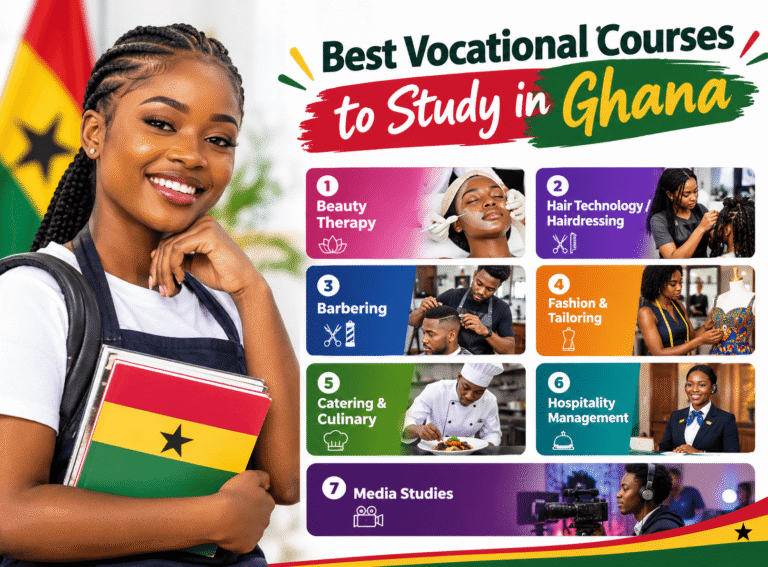
- Fashion and Design (Men’s Tailoring, Dress Designing)
- Beauty and Hair (Beauty Therapy, Hair Technology, Barbering)
- Hospitality and Catering (Catering, Hospitality Management)
- Media Studies
Location Matters More Than You Might Think
If you’re based in or near the capital, a vocational school Accra location offers clear advantages: easier access to internships, exhibitions, industry events and job opportunities that come with being in a major commercial hub. That said, location should be weighed against your daily commute and living situation. A school that’s technically “the best” on paper but requires hours of travel each day may not be the most practical choice for consistent attendance.
If a school operates more than one campus, check whether that gives you flexibility. Multiple locations in and around a city can make it easier to choose a campus close to home or work, without compromising on the quality or accreditation of your training.
Ask About Scheduling Flexibility
Not every prospective student can commit to weekday classes. If you’re working, running a household, or studying elsewhere, look specifically for schools that run weekend or evening programmes as part of their standard vocational training Ghana offerings, not as a rare exception. A dedicated weekend school, with clearly published hours, signals that an institution has built its programme around real student circumstances rather than assuming everyone has weekday freedom.
Check the School’s Track Record
Reputation built over time is one of the most reliable indicators of quality. Ask:
- How long has the school been operating?
- How many students has it trained?
- Where are past graduates now working, or what businesses have they started?
A school with a long, verifiable history of turning students into working professionals is generally a safer bet than a newer, unproven provider, especially for a decision as significant as your training and certification.
Compare Fees Against What’s Included
Fees will vary depending on the course, duration and schedule (full-time vs weekend). Rather than comparing headline prices alone, ask what’s included: registration, materials, assessment fees, and any additional costs for equipment or ingredients. Contact each school’s admissions office directly for a full, current breakdown, since published fees can change and often depend on your specific course choice.
Why Abrantie College Stands Out as the Best Vocational School in Ghana
Weighing all of the criteria above, Abrantie College is a strong answer to the question of which best vocational school in Ghana to choose. Founded in Accra in November 2007, the college has trained more than 10,000 practitioners over nearly two decades, many of whom now run their own salons and fashion businesses or hold leadership roles in industry and education.
On accreditation, Abrantie checks every box: it is recognised by the GES, NVTI, TEU and C-TVET, holds IQAF recognition, and is professionally affiliated with GNAPVTI, GNAGM, PCABAG, ACSG and ASSI. Its affiliation with Accra Technical University also gives graduates a genuine pathway into HND and BTech-level study, making it one of the more complete accredited vocational school Ghana options for students who may want to continue their education later.
As a well-established vocational school Accra students can access easily, Abrantie operates two campuses — the main campus at Baatsona on Spintex Road, and an annex at Sakumono — putting quality training within reach across the greater Accra area. Its seven course areas cover Men’s Tailoring, Dress Designing, Beauty Therapy, Hair Technology, Barbering, Catering, Hospitality Management and Media Studies, all delivered through Competency-Based Training with experienced facilitators.
For students balancing work or other commitments, Abrantie runs a dedicated weekend school (Saturdays 8:00am–5:00pm and Sundays 1:00pm–5:00pm), and welcomes applicants from across Africa and beyond regardless of language background. This combination of verified accreditation, hands-on vocational courses Ghana students can rely on, flexible scheduling, and a long, visible track record is exactly what the checklist above calls for.
Final Checklist Before You Enrol
Before signing up anywhere, confirm you can answer yes to each of these:
- Is the school accredited by recognised bodies such as GES, NVTI, TEU or C-TVET?
- Does it use hands-on, competency-based teaching methods?
- Does it offer the specific course (or combination of courses) you want?
- Is the location realistic for your daily commute?
- Does it offer a schedule that fits your current commitments?
- Does it have a verifiable track record of successful graduates?
- Have you received a clear, written breakdown of fees?
Final Thoughts
Choosing the best vocational school in Ghana is less about finding the most advertised option and more about matching accreditation, teaching quality, location, schedule and cost to your specific needs. Abrantie College’s nearly two-decade track record, full accreditation, wide course range and flexible weekend school make it a strong, well-rounded choice for students across Accra and beyond. Reach out to its admissions team directly to discuss your course of interest and get a clear picture of fees and start dates.